Building an AI Investment Dashboard: What We Learned From Raziel
Most investors cannot say what their private portfolio is worth today. Fixing that is less about charts and more about data, trust and one well placed AI feature. Here is how we approached it with Raziel.
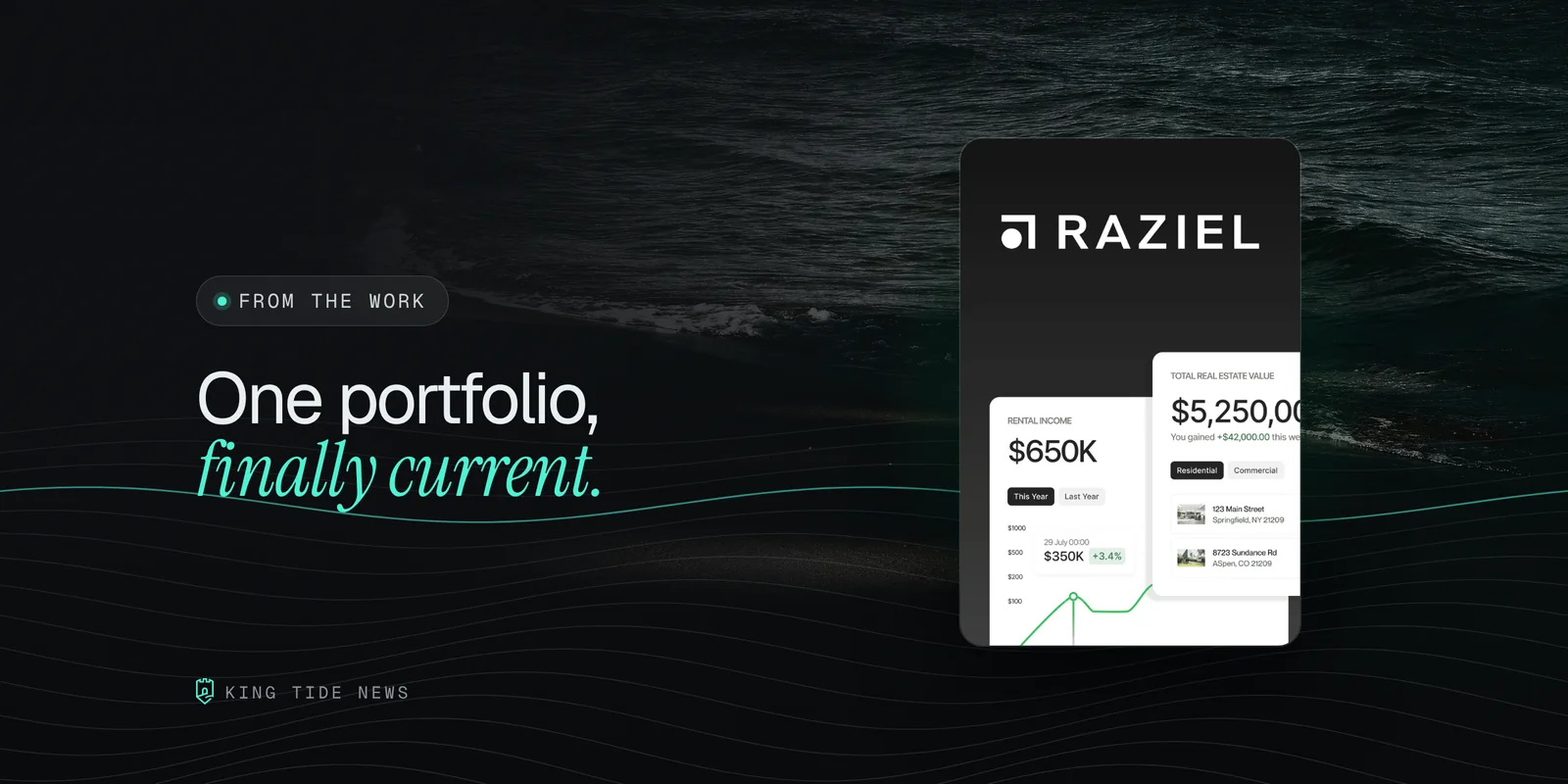
An AI investment dashboard is only useful if it answers one question better than a spreadsheet: what is my private portfolio worth today, and why? Charts come later. First you need every position recorded correctly, returns calculated from real cash flows and an AI that removes the paperwork instead of adding a chatbot. We learned that building Raziel, the alternative asset management platform we incubated from an idea, where investors track startups, SPVs, funds and entities in one dashboard with live MOIC, IRR and valuations.
This piece covers what the product has to do, why the data model matters more than the interface, where AI earns its place, how to design for trust, and how to scope a first version. It comes from the same playbook we use for every AI MVP we build.
The problem an investment dashboard has to solve
Angel checks, SPV allocations, fund commitments and entity holdings tend to live in a dozen inboxes, portals and spreadsheets. Each source is accurate on its own. Together they never add up to a number an investor trusts, and the founders those investors back still send updates as long email threads.
That shapes the brief. The job is not "show investments nicely." It is:
- Put every holding in one place, whether it is a direct deal, an SPV, a fund or an entity.
- Keep each value current, so up-rounds and capital calls show up as they happen.
- Explain every number, with each figure linking back to the position behind it.
At Raziel, we wrote the brief in one line: kill the spreadsheet every investor keeps. Every feature decision after that was tested against it.
Get the data model right before the interface
The most important part of an investment dashboard is invisible. If positions and cash flows are modeled loosely, every chart on top of them is wrong in a way users eventually notice, and in finance one wrong number costs more trust than ten good screens earn.
A few principles held up for us:
- Record cash flows, not just totals. Raziel calculates MOIC, IRR, TVPI and DPI from real cash flows. Capital calls are recorded as cash flows, so returns stay honest instead of looking better than they are.
- Treat funds and direct deals as equals. LP positions sit next to the companies an investor holds directly: commitments, capital called, NAV and distributions in the same view.
- Roll up, then drill down. Totals by company, fund, SPV and entity, with every figure one click from its source.
- Show what changed. Investors want to see what each holding is worth now, how it got there and what changed this week.
None of this is glamorous, and it is where most of the early engineering time should go.
Where AI belongs in an AI investment dashboard
The most useful AI in this category is not a chat window. It is the feature that removes the biggest chore: typing documents into the system.
In Raziel, investors forward the paperwork. The AI reads SAFEs, purchase agreements and capital account statements, pulls out the amount, security type, valuation cap, discount and dates, matches them to the right company, fund or SPV, and turns a PDF into a tracked position. Then the investor confirms it.
That last step matters as much as the extraction. We wrote about the pattern in designing AI products: people trust results they can check. Three design choices follow from it:
- The AI proposes, the investor decides. Nothing becomes a position without a confirmation.
- The AI stays optional. Anyone can enter a position by hand, and the AI stays under the investor's control.
- Customer data is not used for training. Investors are trusting you with private deal documents, and that promise belongs in the product, not just the privacy policy.
Document processing is also where model cost lives, so how much of each document reaches the model is a product decision. We cover that tradeoff in what LLMs really cost a startup.
 Case study · RazielEvery alternative investment, in one place.See the work
Design for trust from day one
Investors will not upload a cap table to an app they do not trust. In fintech, trust is part of the product, and it shows up in two places.
Security that users can feel
Security at Raziel was designed into the product, not added for a checklist: mandatory multi-factor authentication, strict per-account data isolation, role-based permissions in each workspace, Face ID on iOS and no training on customer data. Users never read an architecture diagram, but they notice when sign-in asks for a second factor and when a teammate can only see what their role allows.
It also changes how the code gets reviewed. Authentication, permissions and anything touching personal financial data should always get a person's review, even with AI tools in the loop, which we explain in AI code review for startups.
A brand that feels calm
Money this private deserves a brand that feels calm and expensive. For Raziel we paired an editorial serif with a precise sans, a near-black and teal palette and black and white architecture photography: towers, concrete and glass that say permanence without saying finance. A fintech product that looks like a weekend project asks users to forgive it. Our brand identity work starts from that idea.
The second side: founders and growth
An investment dashboard gets more valuable when the other side of the table uses it too. Raziel gives founders their own workspace: an investor CRM with a Kanban pipeline from first email to wired, investor updates with read tracking, and a cap table and KPI dashboard kept current for the next conversation.
Two more pieces finished the product:
- Mobile. Native iOS and Android apps, live on the App Store and Google Play, so investors can check a position between meetings and founders can move an investor after a call.
- A growth engine built into the product. Raziel has 21 free investment calculators for IRR, MOIC, TVPI and DPI, SAFE conversion, dilution and liquidation preferences, plus guides and comparisons. Each answers a real search and ends one click from a free account.
Today Raziel tracks $4.2B in assets for more than 1,200 investors and syndicates. That did not come from the first version. It came from getting the core right, then adding sides and channels on top of it.
How to scope a first version of an AI investment dashboard
If you are building in this space, do not start with everything above. Start with the smallest product an investor would use every week.
- Positions and cash flows. Manual entry that is quick and correct, for the two or three asset types your first users hold most.
- One honest portfolio view. A total, returns calculated from cash flows and a drill down to each position.
- One AI feature. Usually document import, with a confirmation step.
- Security basics on day one. Multi-factor authentication, data isolation and roles are much harder to add later.
Leave the founder side, mobile apps, integrations and calculators for later, unless one of them is your actual wedge. If your product gives anything that looks like investment advice, holds customer money or handles regulated data, have a lawyer who works in financial services review it before launch, and plan that time from day zero.
At King Tide, a focused first version starts at $4,999, and a full AI MVP is usually around $15K, at a fixed price agreed before we start. Our guide to what an MVP costs breaks down what moves that number. We have done fintech product work beyond Raziel too: we lead all product, UX and UI design for Mural Pay, and designed the brand, website and product UX for Findigs.
The takeaway
An AI investment dashboard wins on accuracy and trust, not on charts. Model positions and cash flows properly, calculate returns from real data, use AI to remove the paperwork with the investor confirming every result, and build security in from the first release. Then add the second side, mobile and growth once investors rely on the core. If you are planning a fintech or AI product and want a crew that has built one from an idea, tell us about it.
Questions founders ask
What is an AI investment dashboard?
An AI investment dashboard brings an investor's holdings into one view, with current values and returns, and uses AI for the slow manual work, such as reading investment documents and turning them into tracked positions. Raziel, which King Tide incubated, does this for startups, SPVs, funds and entities on the web, iOS and Android.
How does AI help track private investments?
Mostly by reading paperwork. In Raziel, investors forward SAFEs, purchase agreements and capital account statements, and the AI extracts the amount, security type, valuation cap, discount and dates, matches them to the right company, fund or SPV, and creates a position the investor confirms.
What features should a first version of an investment dashboard have?
A clean way to add positions, cash flows recorded properly, a portfolio total with returns calculated from those cash flows, and one AI feature that removes the biggest manual chore. Founder tools, mobile apps and growth features can follow once investors use the core.
How much does it cost to build an AI investment dashboard MVP?
At King Tide, a focused first version starts at $4,999 and a full AI MVP is usually around $15K, at a fixed price agreed before the build starts. Integrations, mobile apps and compliance work push a build toward the larger end.
Who built Raziel?
King Tide incubated Raziel from an idea: the brand, the website, the UX and UI, the full-stack AI product and the iOS and Android apps. We also invested in its Seed round.